Telecommunication refers to the exchange of information by electronic and electrical means over a significant distance. There are two broad forms of telecommunication, as classified by the telecommunications (telco) industry: voice and data. Voice refers to the communication of sound over a distance using wired or wireless telephones and related technology. Data, as the name suggests, refers to communication using internet and data services technology.
According to Wikipedia, open communication refers to the ability for individuals to access and share communication resources freely. This blog post seeks to advocate for the open access to both voice and data communication services around the globe. Such open access has the ability to truly transform the day-to-day lives of billions of individuals, as we will explore below.
Technology drives cheaper voice and data
Average revenue per user (ARPU) is a key operational metric used by telco companies to measure firm performance. ARPU is calculated by dividing total revenue by total number of telco subscribers / users. In the 2000s and 2010s, as data from 2G and 3G services became more mainstream, the telco industry saw voice ARPU decline, while data ARPU grew. For example, South Africa saw a 10% decline in traditional voice revenue as data applications (e.g. WhatsApp) are substituting for voice.
More recently, however, several countries across the globe have seen ARPU from both voice and data have continue to decline. Figure 1 shows this decline over the 10 year period from 2006 – 2016.
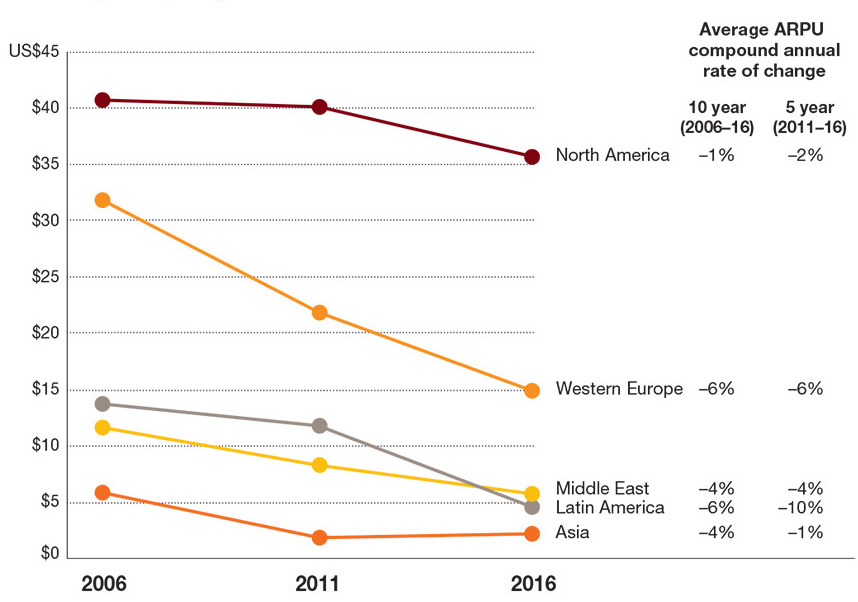
ARPU has been declining across the globe due to technological advancements
Source: PwC
Note: graph does not include information on Africa
It is key to note from Figure 1 that North America has seen the least decline in ARPU between 2006 – 2016. This may in fact be due to the oligopoly nature of the telco market in the United States, where both regulators and private companies collude to ensure that ARPU declines are less drastic compared to those in other regions around the globe.
Declines in ARPU are driven by advances in technology, which create a unique, double-edged sword for telco companies. As customers demand improvements in speed, latency and coverage, telco companies are forced to respond with improved products backed by technological advancements. However, the efficiencies of such advancements drive ARPU down, as both voice and data become cheaper. Also, video content and social media are replacing voice for how people communicate. Thus, we increasingly find telco companies offering value-added services (VAS) beyond their traditional product mix of voice and data in order to offset this decline in ARPU. Looking ahead, ARPU from voice and data is only projected to decrease further as the benefits of the Fourth Industrial Revolution (4IR) kick in. Figure 2 highlights EY’s view on what the telco industry will look like in 2025 under the 4IR.
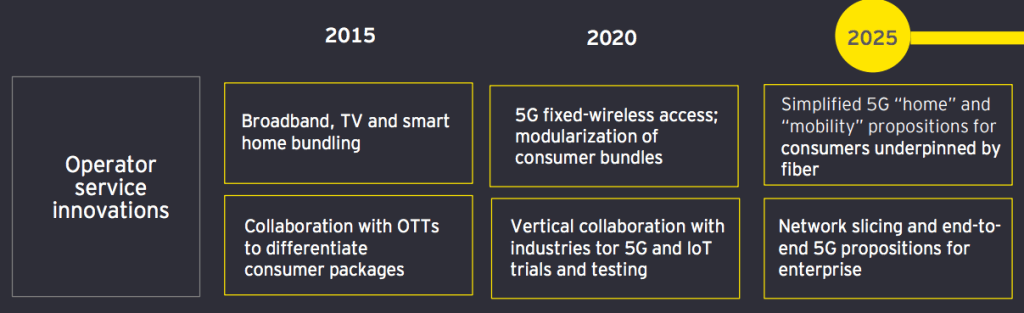
EY’s view on how the telco industry will provide differentiated VAS under the 4IR
Source: EY
From the above, we conclude that telco companies will soon see ARPU from voice and data collapse to near-zero levels due to further technological advancements. This will likely be driven by the benefits of the 4IR (particularly 5G), and is an inevitable future view of the industry. Telcos that embrace free voice and data, and offer unique, differentiated VAS, will continue to succeed in the 4IR world.
Open access to voice and data must be a fundamental human right
The United Nations’ Universal Declaration of Human Rights (UDHR)is a “common standard of achievements for all peoples and all nations” and sets out, for the first time, “fundamental human rights to be universally protected”. The UDHR was first proclaimed in Paris in 1948. According to Article 27 of the UDHR, “everyone has the right freely to participate in the cultural life of the community, to enjoy the arts and to share in scientific advancements and its benefits”.
As detailed in this blog by Scott Edwards of Amnesty International, access to communication technologies must be thought of as a fundamental human right. While Edwards’s blog focuses more specifically on internet access, the same argument holds true for access to voice and data technologies. In fact, data services are essentially internet access on mobile phones. These Information Technologies are essential for individuals in the 21st century to enjoy basic fundamental rights including health, education and employment. Open access to voice and data will likely boost the number of individuals who have regular access to the internet. Figure 3 highlights regular internet access by country around the globe. By accessing the internet more regularly, individuals will be able to enjoy benefits of better life outcomes, including equity within communities.
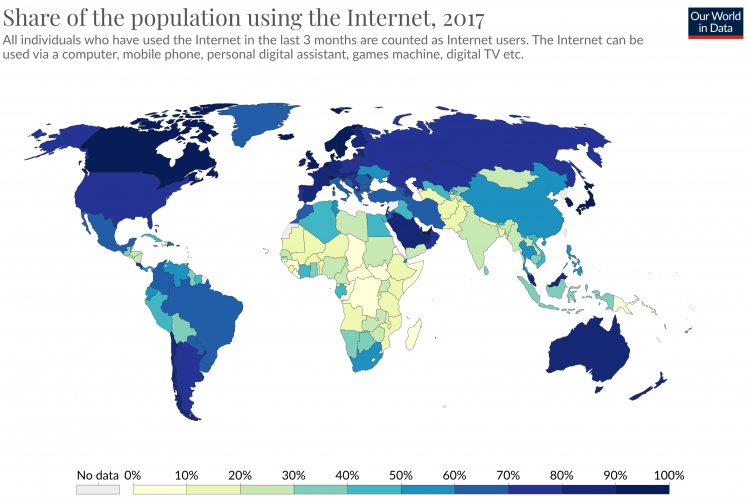
Share of population, by country, that uses the internet
Source: Our World in Data
Thus, there are several societal benefits to individuals’ open access to voice and data communication. This, in addition to the fact that near-zero ARPU will be the new norm (see previous section), supports the rationale for open voice and data.
Private telcos and regulators are key to success
Every open access solution has certain nuances / factors that will ensure its success. In the case of open communication, this takes the form of private telcos and regulators, as explained below.
First, it is unlikely that an OSD-powered solution for open communication will succeed. This is because of the high potential for bandwidth and capacity issues associated with OSD solutions. These issues, particularly user entitlement, have been highlighted in my first blog of this semester. Thus, it is likely that private telco companies will need to drive the open communication movement. This is not necessarily a bad outcome. Private telcos currently have access to the required infrastructure to accommodate increased bandwidth and capacity associated with open communication. There may be room for the government / public sector to nationalize voice and data services, while the private sector focuses on providing unique VAS. However, this will likely be opposed in the West due to anti-socialist sentiments.
Second, regulators will need to play a key role in pushing private telcos to adopt open communication. This will be done only if regulators prioritize the welfare of consumers over the profits of private telcos. This will also ensure fairer competition in the largely oligopolistic telco market in the United States.

