This blog seeks to compare intellectual property (IP) to open source design (OSD) as the two alternatives to determining the right-of-use of human-created solutions.
What is intellectual property?
IP refers to unique, value-adding creations of the human intellect that results from ingenuity, creativity and inventiveness. IP rights have been developed over the last 150 years and are a core component of capitalist societies. IP right holders have the right to exclude other players from using specific IP for commercial purposes.
IP enables entrepreneurs, start-ups and SMEs to protect themselves during different stages of growth. Specific IP rights, such as patents or trade secrets, enable smaller entities to gain access to much-needed capital to scale their operations. This access to capital enables firms to enjoy sufficient profits to re-invest in R&D, innovation and growth. Adopting an IP-oriented view of the world comes naturally to me, given my academic interests and work experience being in commerce.
What is open source design?
Open source design (OSD) refers to the development of technology and ideas without the retention of IP rights. Copylefts are key to OSD – these ensure that work generated through open source is open and free for anyone to use. OSD ensures free, open collaboration. OSD developed out of Silicon Valley and the tendency to openly share code with one another to design better software systems. Interestingly, the first time any code was prevented from being shared was in the 1980s with AT&T enforcing IP rights. I initially struggled to see the merit of OSD, particularly from the standpoint of scaling a new business.
OSD seeks to democratize innovation through open collaboration with the public. OSD is likely to invoke motivation at the higher end of Maslow’s hierarchy of needs, namely esteem and self-actualization. The underlying theme here is one of bringing a community together to solve a problem; the community could in fact be each and every person around the world. The primary benefit of OSD is to gain multiple perspectives to a problem and to openly collaborate with one another. There is also a sense of seeking to correct global inequality through OSD.
Critics of IP and OSD
Critics of IP point to the system’s lack of fair distribution of innovation across the globe. There is an accumulation of knowledge, resources and capital amongst certain countries. Consider Figure 1 below, which shows that LATAM, Africa, Eastern Europe and the Middle East barely own any patents, with this trend projected to continue.
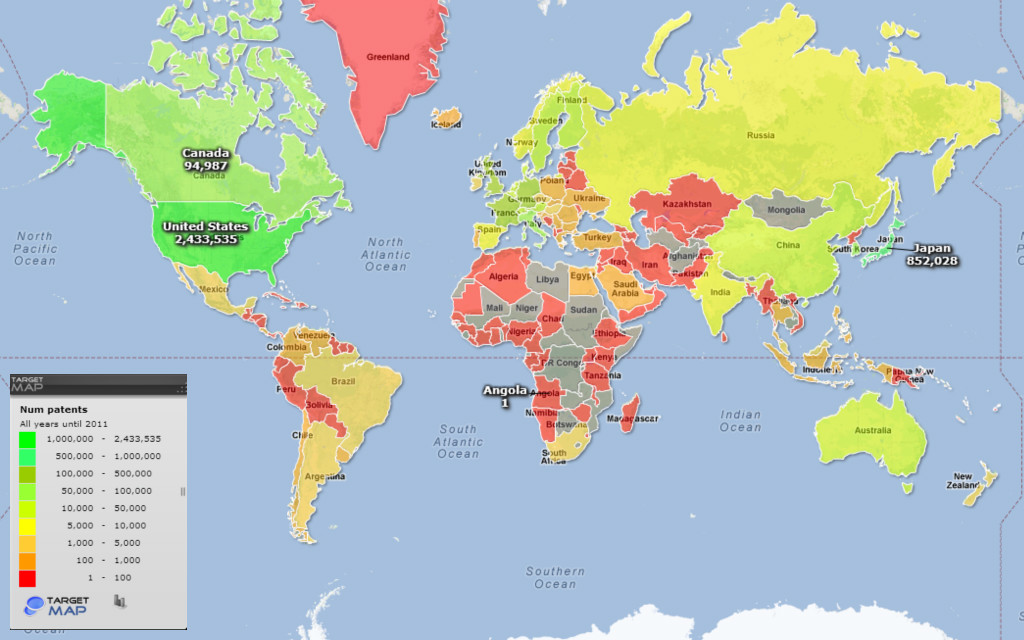
Further, IP rights were initially set up to protect individual creativity rights; however, a majority of IP rights today are held by corporations. Finally, securing patents is an extremely time-consuming and resource-intensive process. For instance, securing a patent can quickly cost more than $15,000 if the patent is “complex” to “highly complex” (IP Watchdog). This can often prove very expensive for inventors and individual entrepreneurs who lack such resources. Thus, we see that there definitely is a lack of democratization of innovation, as innovation is concentrated in previously wealthy / technologically-advanced countries.
An increasing number of customers and product / service users are demanding a transition to OSD. IP critics point that failing to ride this wave can prove detrimental to a firm’s success. Instead, they advocate for companies to transition their product and service offerings to OSD, as seen in the case with HP’s e-speak (HBR). Firms can also have the option to have their strategy developed through OSD. This is seen in the case with Wikipedia (HBR), where users and contributors were invited to openly participate in shaping the company’s next five-year strategy. This enables all stakeholders to be involved in key decision-making initiatives of organizations, particularly customers. This is important as such initiatives can reduce customer acquisition costs and increase customer lifetime value.
Critics of OSD are quick to point to the lack of competition it creates, by using the argument that a lack of competition stifles innovation. Thus, OSD is likely to see lower innovation at the idea-stage. Further, there is a consistent fear of imitation / replication of products and services manufactured using OSD. This can potentially erode huge amounts of a company’s value by neglecting the need for a differentiated brand. For instance, the Coca-Cola brand was recently valued at $73.1 billion, roughly 35% of the company’s market cap (Forbes). IP enables Coca-Cola to protect both its brand, as well as its secret formulas, from being replicated by other beverage manufacturers. In an open-source world, Coca-Cola would unlikely capture the additional value of being a differentiated brand, and may in fact see a decline in firm value due to the prevalence of imitation brands. Finally, even if the world entirely adopts OSD principles to design products and services, execution of designs (where all the value will lie) will be dominated by incumbents who have access to tools and technology required. As the world enters the Fourth Industrial Revolution, Big Tech will continue to profit due to the digital tools (AI, ML, quantum computing) at their disposal. Thus, OSD is unlikely to dramatically push the needle on solving global inequality.
An interesting observation through class discussions, readings and conversations with Prof Etienne is on the motivation of the critics of each system. Critics for both systems can be defined by the region / economic setting that their proposed solution (i.e. product or service will be implemented). Critics of IP support solutions that are often meant to be implemented in the developing world: there seems to be a sense of OSD offering a way to correct the wrongs of imperialism and colonialism and its modern extension through IP concentration in the West. Critics of OSD, on the other hand, often support solutions that are primarily created for the developed West: their ultimate goal seems to be the protection of their dominant position in the global economy, as seen in figure 1.
The next few decades will prove interesting in determining the true drivers of the IP v OSD debate. As developing economies secure developed economy status – for instance, China plans to become an advanced economy by 2049, as well as the world’s largest economy (The Atlantic). As global economic roles switch, would we see OSD advocates increasingly from the developed West?
Conclusion
The discussion above suggests that solely adopting either of IP or OSD is unlikely to benefit the world. Solely adopting IP is likely to further widen the gap between the haves and the have-nots. Solely adopting OSD may prove to be the “right thing to do”, but will have severe consequences on global growth. As Vice points out, relying completely on OSD – particularly open source software – drives the burnout of contributors. There is a free-rider problem, where individuals and companies make use of open source software without “giving back enough”. This is termed as user entitlement; thus, in a pure OSD world, the number of users as well as their development requests far outweigh the number of contributors, leading to contributor burnout, which in turn can compromise the entire open source solution. A key example of the consequences of contributor burnout can be seen in the case of Heartbleed, a bug in OpenSSL, which essentially gave hackers open access to users’ personal information.
Thus, we need a middle ground that incorporates beneficial components of IP and OSD. For instance, OSD can be leveraged to successfully collaborate on innovation at the idea-generation stage, while IP should be leveraged to protect entrepreneurs and firms who seek to deliver this innovation on the world stage. IP is required here given the capitalist nature of today’s world; entrepreneurs and firms are unlikely to succeed if OSD is extended to the delivery stage. This approach has been successfully adopted by firms such as Tesla and Dropbox. Tesla has released all of its patents as open source, effectively meaning that any individual or organization is free to use its patents to develop electric vehicles. It’s interesting to note that Tesla still owns the trademark to its brand, most likely to build brand value as identified in the Coca-Cola example above. Dropbox has adopted a hybrid approach of using core OSD technology and leveraging IP rights to protect its own unique offerings.
However, a key exception to the above must be on issues that pose a threat to humanity. For instance, OSD should almost exclusively be leveraged to develop and execute solutions to tackle climate change. This has the potential to cause severe harm to humanity by the end of the 21st century if not addressed.
Note: blog updated on 2/3 to reflect changes recommended by Laura.


2 thoughts on “IP and OSD solutions compared”