Coronavirus disease 2019 (COVID-19) is an infectious diseases caused by severe acute respiratory syndrome coronavirus 2 (SARS-CoV-2). COVID-19 first emerged in the Chinese city of Wuhan in December 2019, and has now infected 1.6 million individuals in 184 countries around the world (as of April 9, 2020). As Figure 1 shows, COVID-19 has disproportionately affected the United States and Western Europe, despite originating in China.
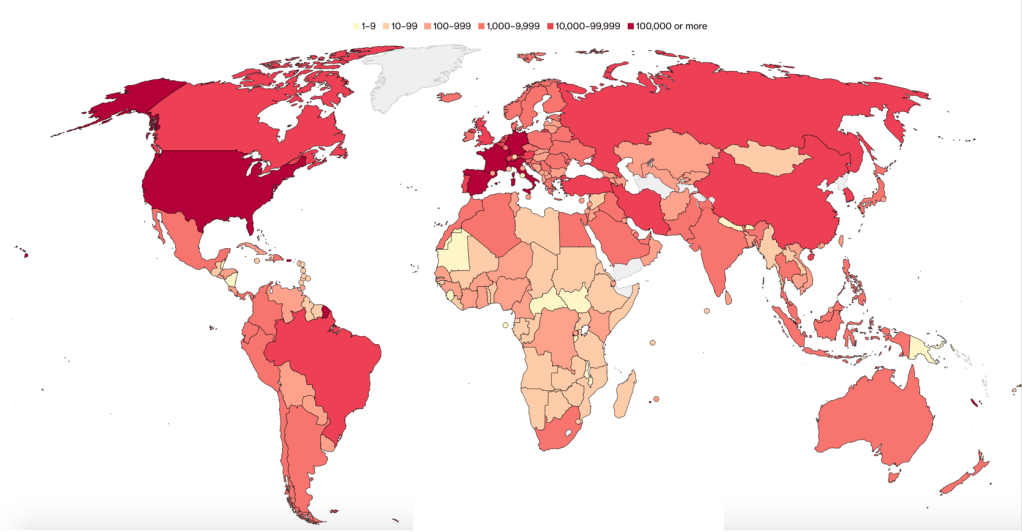
COVID-19 has spread rapidly across the world, affecting the United States and Western Europe more than its origin nation of China.
Source: Bloomberg
The spread of COVID-19 has increased exponentially during the month of March 2020. This is detailed in Figure 2. Thus, the virus has spread aggressively in the United States and Western Europe over the last 30 days alone. COVID-19 has only just started to spread to the developing world, including India, Latin America and Africa. It remains to be seen whether the virus can be curtailed in these regions.
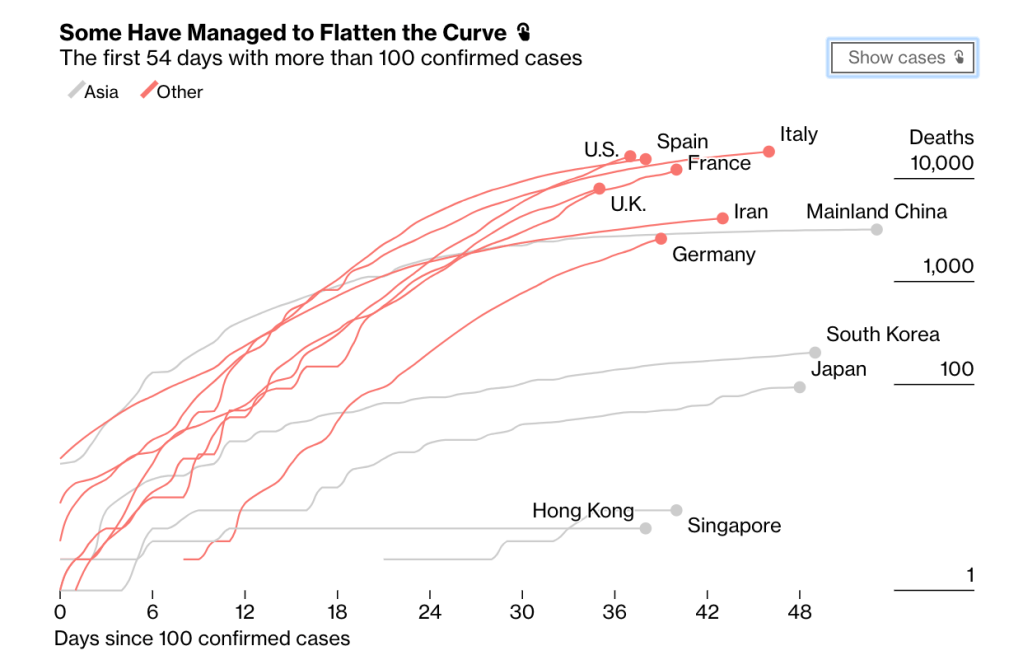
COVID-19 has spread exponentially during the month of March 2020, recording a 10.3x increase in 30 days.
Source: Bloomberg
COVID-19 has had unprecedented, detrimental impacts on the world society and economy. The global death count stands at 95,506, with the United States accounting for 17% of all deaths (as of April 9, 2020). Countries all over the world have imposed travel restrictions in order to contain the spread of the virus, as shown in Figure 3. With 2.6 billion people (32.5% of the world’s population) under strict lockdown measures, COVID-19 will likely lead to the world’s worst recession since the Great Depression of the 1930s, according to the International Monetary Fund.
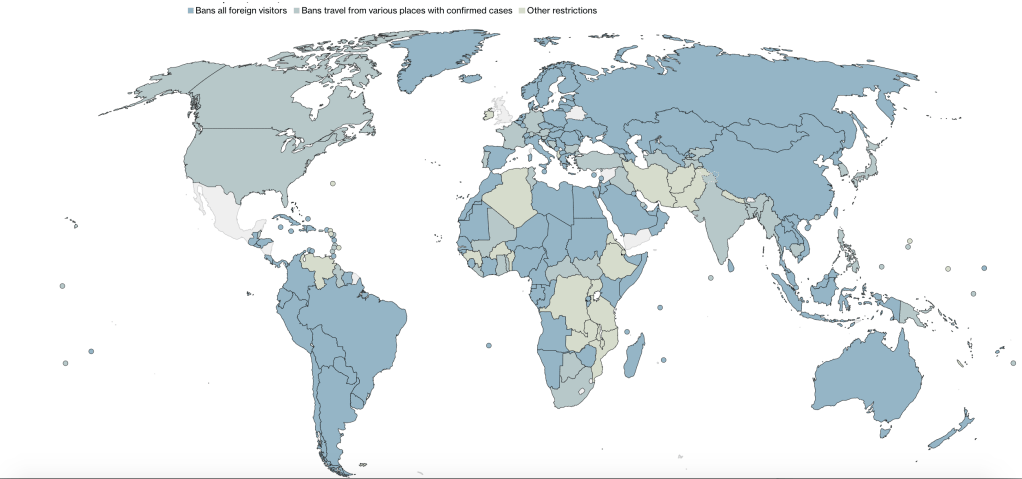
Countries across the world have imposed travel restrictions in order to curb the spread of COVID-19.
Source: Bloomberg
The central issue in the global fight against COVID-19 is the high degrees of uncertainty regarding the spread of the virus. This is primarily driven by the fact that the world is at least 18 months away from a COVID-19 vaccine. Thus, the only way for nations to limit the spread of the virus is through strict lockdowns, given the highly contagious nature of COVID-19. Such lockdowns will only push the global economy deeper into a downturn as long as these remain enforced.
This blog will explore how governments and multilateral organizations can support OSD health interventions during pandemics, within the context of COVID-19. Specifically, there is a significant opportunity for OSD principles to be leveraged in order to advance the development of vaccines and reduce their cost for end users.
Private companies drive up the cost of vaccines
Recent estimates suggest that the cost of developing an average vaccine – from research and discovery to product registration – lies anywhere between $500 million to $1 billion. The main driver of these high costs are the research and development (R&D) expenses that are incurred by private pharmaceutical companies. This is also the most frequently publicly-cited reason by these firms for high prices of vaccines.
It is key to note the crucial role that taxpayers play in R&D in the pharmaceutical industry. The National Institute of Health (NIH) spends $40 billion annually on health innovation that is driven by the private sector. In fact, NIH funding contributed to the development of each of the 210 new drugs approved by the Federal Drug Administration from 2010 to 2016. Despite leveraging taxpayer money for R&D, drug and pharmaceutical companies repeatedly disavow efforts to make vaccines affordable and accessible to the general public. This is primarily due to the strong pharmaceutical lobby that dictates healthcare policy in the US. A recent example of the lobby’s influence can be seen in Health Secretary Alex Azar’s refusal to promise that COVID-19 vaccines would be affordable.
Inability to access vaccines will hurt millions
The lack of affordable vaccines has serious implications for the health and wellbeing of Americans in light of COVID-19, as well as for the global efforts to curb the spread of the virus. As the New York Times details, COVID-19 tests are free across the US and some insurers in certain states are waiving the costs of COVID-19 treatment. Thus, individuals covered under Medicare or Medicaid, and those who qualify for insurance under the Affordable Care Act are likely to face little or no medical bills related to COVID-19. However, questions do remain on how much the roughly 30 million uninsured individuals will need to pay for COVID-19 treatment.
COVID-19 will also soon remind the world of the many inequalities that exist between nations, as the virus continues to spread in the Global South. 900 million people are at risk from the coronavirus in the world’s least developed countries (LDCs). Countries like India, and regions such as Latin America and Africa will need the most medical and economic support. Unlike in the United States, many governments in these regions cannot afford to support their economies for extended periods of time. For example, the IMF recently announced that Zimbabwe’s foreign exchange reserves were only sufficient enough for one week’s worth of imports. It is key to note that vaccine coverage, in general, tends to be closely linked to socioeconomic status. This means that poorer countries already start at a much lower baseline on vaccine coverage compared to the developed world.
Lack of economic incentives restricts development of vaccines for pandemics
From the sections above, we see that the inability to access affordable vaccines will leave millions in the US and around the world vulnerable to the risks of COVID-19. This will likely continue the rise in the number of cases and deaths associated with the coronavirus.
The root cause of this issue is the lack of incentives for pharmaceutical companies to invest in affordable vaccines. Recent history shows that vaccines for outbreaks such as Ebola and Zika were developed well-after these outbreaks were brought under control. As a result, drug companies lost money over vaccines developed for these outbreaks. This likely reduces the economic incentives that pharmaceutical companies have today to develop vaccines for COVID-19. Regulatory and public pressure to provide affordable vaccines further reduces such incentives. The result is a significant underinvestment in vaccines that will lead to huge societal benefit.
COVID-19 vaccine price guarantee as a solution
DeMarzo et al propose a unique, OSD-driven intervention to ensure that pharmaceutical companies have the right economic incentives to develop vaccines for COVID-19. Their proposal looks at a price guarantee from the United States government for COVID-19 vaccines. This will ensure that pharmaceutical companies will recover their R&D costs on such vaccines. This price guarantee will alter the risk-reward dynamic for pharmaceutical companies, and will serve as an effective economic incentive for these firms to direct all resources to develop a COVID-19 vaccine. Price guarantees will also enable open access to vaccines for all individuals in the United States, irrespective of socioeconomic status or insurance coverage status.
The United States government will not lose from such an intervention. The cost of this price guarantee will be instantaneously recovered as the economy returns back to normal once vaccines are administered across the country. For instance, let us assume that the price guarantee by the US government will stand at $250 per vaccine dosage, amounting to $80 billion to vaccinate the entire country. This amounts to roughly two weeks of lost economic output in the US, under very conservative estimates, which will be soon recovered once the economy returns to normal conditions.
The concept of this price guarantee can be extended to include contributions from governments around the world, such as those in Europe. Multilateral organizations, particularly the World Bank and the World Health Organization, can contribute to this price guarantee on behalf of countries in the developing world. Once again, there will likely be no economic loss to this contributions, as the world economy’s resumption of normal activities will soon cancel out the costs associated with the price guarantee. Most importantly, individuals in the world’s poorest regions will be guaranteed open access to vaccines.
Critics to the price guarantee approach may point out how this may be a violation of free markets. While there may be some merit to this argument, it is key to note that governments, central banks and multilateral organizations are being forced to participate in free markets to protect lives. Big government is back, and may in fact be here to stay. COVID-19 presents an unprecedented threat to life as we know it and we must be prepared to implement unorthodox solutions to mitigate this threat.

