The World Bank Group (WBG) and the International Monetary Fund (IMF) are amongst the most relevant and the most consequential multilateral organizations in the world aimed at reducing inequality. Their vast membership bodies mean that they govern the economic development of the world economy: the WBG and the IMF each have 189 countries as members. Their mission statements also reinforce the power and the influence that they exercise on the world economy: the WBG seeks “to end extreme poverty and to promote shared prosperity” (The World Bank) , while the IMF aims “to ensure the stability of the international monetary system” (The International Monetary Fund).
This blog seeks to discuss how the WBG and the IMF have historically failed at reducing economic inequality and recommends an alternative approach of adopting OSD to better achieve their objectives.
The WBG and the IMF have core American roots
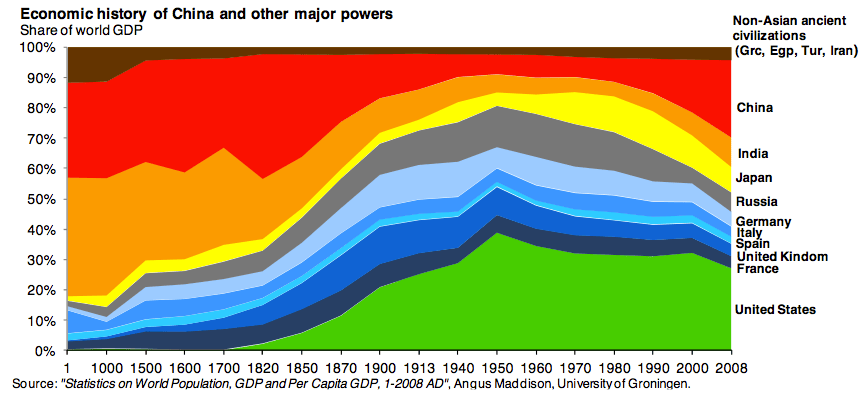
Both the WBG and the IMF were created during the final days of WW2 as the Allied Powers approached victory. The two organizations were outcomes of the 1944 Bretton-Woods Conference, an event which also saw the US dollar emerge as the world’s international reserve currency. The Conference has often been described as an event that elevated the United States to the status of an undisputed global superpower. The United States – as the only industrialized nation not damaged by war during WW2, as well as through the WBG and the IMF – was in a prime position to enjoy economic growth. This resulted in the United States dominating the world economy for most of the second half of the 20th century, as shown in Figure 2 below.
Source: The Atlantic
As seen from their mission statements above, both the WBG and the IMF seek to directly promote economic growth and stability, with reduction in inequality being an indirect consequence of achieving their goals. It is interesting to note that neither organization explicitly mentions reducing inequality in their mission statements.
Multilaterals have historically promoted American economic interests
An alternative approach to viewing the operations of the WBG and the IMF is one where the US seeks to advance its interests globally through both organizations. This view is reinforced through the following phrase from a dated New York Times article: ” … the US Treasury, which is viewed as the power behind the IMF.” Further, the US is the largest shareholder in both the WBG and the IMF. Through their programs and interventions, both the WBG and IMF seek to make each country lean more towards core American values of a liberal society and a capitalist economy (The New York Times). This makes sense when looking at history: every superpower always has had an interest in protecting its position by having other countries align with their economic interests. For example, the British Empire reinforced its superpower status by successfully colonizing 25% of the world’s population (Wikipedia). While this analogy does not hold true on military colonialism, it does serve as an historic example on how superpowers seek to hold onto their dominant status.
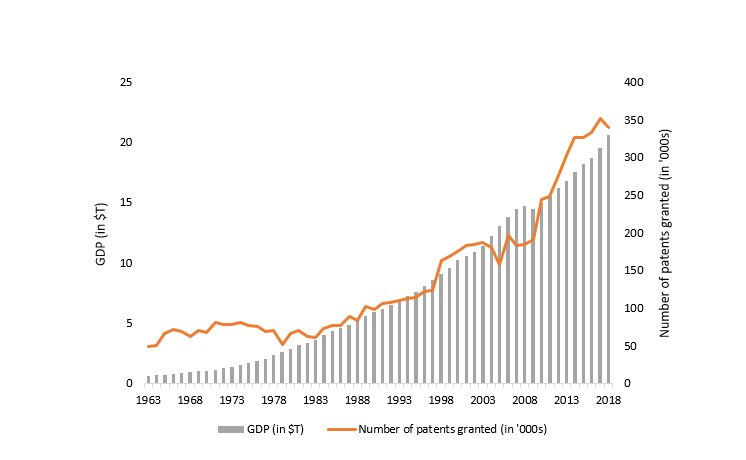
A key component of any successful capitalist economy has been the existence of legally-binding IP rights. This relationship is clearly seen in the historical economic success of the United States, especially post WW2. As Figure 3 shows below, we see a strong correlation between annual US GDP and number of patents granted annually in the US.
Source: US Patent and Trademark Office and International Monetary Fund.
Note: Lack of USPTO data makes limits pre-1963 analysis.
Thus, from Figures 2 and 3, we are able to state the following: the United States was the leading nation contributing the most to the global economy post-WW2, and cemented its position by an aggressive use of IP rights. Further, the United States has been able to maintain its grip on the world economy through the WBG and the IMF.
The WBG and the IMF aren’t doing enough to reduce economic inequality
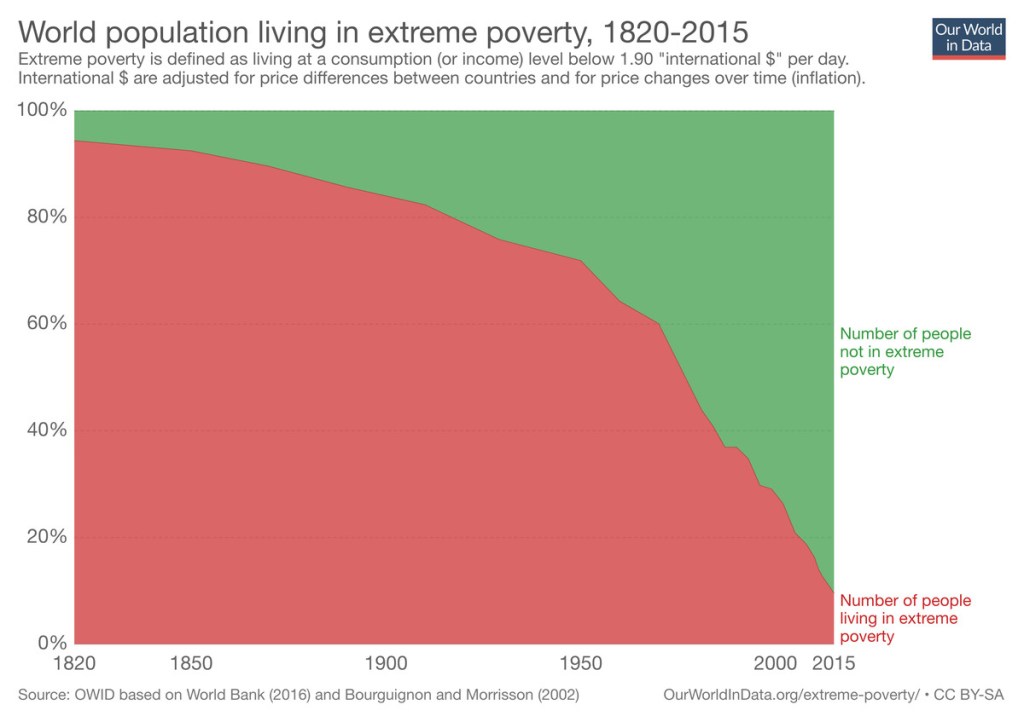
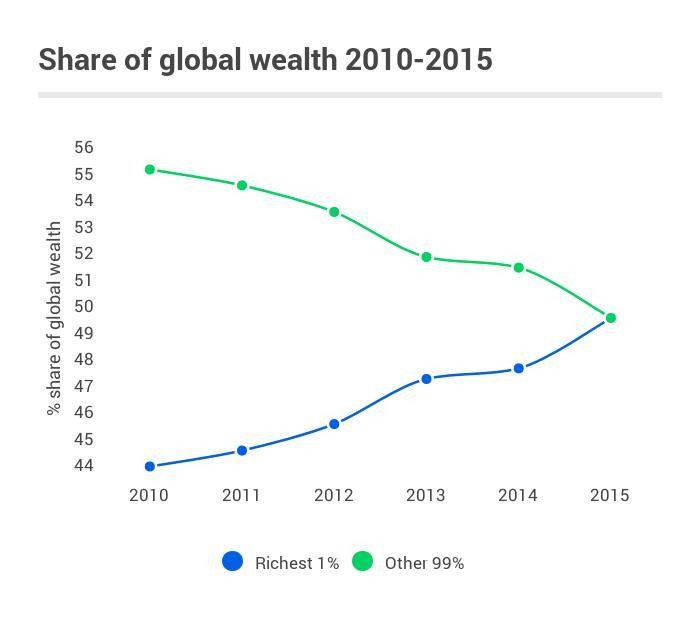
During this same time frame, we have seen two other important trends emerge. First, the number of people living in extreme poverty has reduced drastically. Second, despite this, the economic inequality gap has continued to widen. These two trends are shown in Figure 4 and Figure 5, respectively. Thus, while it is true that capitalism in its purist form (along with the enforcement of IP rights) has lifted millions of individuals out of poverty, it is also true that this very system continues to widen the inequality gap.
Source: OurWorldInData
Source: World Economic Forum
The IMF, in its efforts to nudge countries to adopt capitalism in its purest form, has seen some interventions fail. An example discussed in class was of Jamaica. Over the last 41 years, the country has failed 11 of 15 IMF agreements (Jamaica Observer). Jamaica is not alone in this regard. Consider the case of Argentina, which has received 21 bailouts from the IMF. An IMF loan with its growth-inhibiting requirements was the main reason that brought down the Argentinian economy in 2001. Further, Argentina’s most recent bailout by the IMF is on the verge of collapse (The Financial Times).
The WBG has also seen projects being delayed and even entirely failing in their objectives. Specifically, projects supported by the WBG have displaced millions of individuals, particularly in Africa and in Asia (The Huffington Post). Once again, there is a failure to successfully accommodate individuals and communities in impoverished nations through multilateral interventions.
There are common trends that emerge in the failed bailout attempts of the IMF and in failed interventions by the WBG. This was discussed extensively in our class last week. Both multilaterals are often criticized for adopting a macro-led, top-down analysis of economies. Such an analysis does not work for smaller economies that are not as mature as that of the United States. Further, these economies suffer from issues of unreliable data collection and poor quality. Finally, impoverished nations may be unable to adopt most of the policy changes that come with such multilateral interventions. The IMF, in particular, is known for pushing aggressive policy changes in such countries. These include laying off public sector employees and raising taxes, including on the poor (Council on Foreign Relations). In light of such developments, is there an alternative approach for the WBG and the IMF to ensure that their interventions successfully reduce economic inequality?
Pursuing stakeholder capitalism through OSD
Recent trends point to a fundamental change in capitalism and what it stands for. The Business Roundtable, a non-profit whose members include the CEOs of the largest and the most powerful companies, recently denounced shareholder capitalism (i.e., capitalism in its “purist form”) in favor of stakeholder capitalism. (The New York Times) Simply put, stakeholder capitalism is an economic system where corporations and firms seek to serve the interests of all their stakeholders, not just their shareholders. The World Economic Forum’s Annual Meeting at Davos earlier this year also embraced the concept of stakeholder capitalism (World Economic Forum). Larry Fink, CEO of BlackRock, the world’s largest asset manager, recently stated that “a company cannot achieve long-term profits without embracing purpose and considering the needs of a broad range of stakeholders” (Larry Fink’s 2020 Letter to CEOs).
Multilaterals, including the WBG and the IMF, must pursue an alternative approach that seeks to promote stakeholder capitalism, and not simply shareholder capitalism, in order to effectively reduce economic inequality. This can be achieved through open source design (OSD) that offers solutions that work for individuals at the community level. A successful example brought to light in one of the class readings was of Aclímate Colombia. This intervention, made successful through government support, used open data to offer tailor-made solutions to the rice farming community across Colombia. The financial upside was enormous: $300M of losses were avoided.
Adopting a community-oriented approach through OSD, driven by open data, will promote tailor-made interventions that are more likely to succeed when compared to top-down, macro-level approaches. Such an approach is also likely to see increased buy-in from communities across the country, even if aggressive policy measures may need to be implemented. This buy-in is crucial to enable the success of planned interventions, and will ultimately see increased effectiveness in inequality reduction.
Conclusion
The WBG and the IMF still have a long way to go in supporting the effort to reduce economic inequality. Their traditional approach of incorporating top-down, macro-led solutions that align with US economic interests has not been as effective as envisioned. Both multilateral organizations must instead adopt an OSD approach, driven by open data, in order to democratize the effort to reduce economic inequality.
It is important to recognize that advocating for open data will be challenging. There are likely to be increased efforts and costs (e.g. time and resources), especially when working with countries that lack technological capabilities to do so. However, such an approach will likely see more community buy-in and more success in reducing economic inequality.

