Climate change is a global challenge, and it is clear that we are not doing enough. The G20 countries account for ~80% of the world’s CO2e (carbon dioxide equivalent) emissions. Each country’s contribution to CO2e emissions is shown in Figure 1.
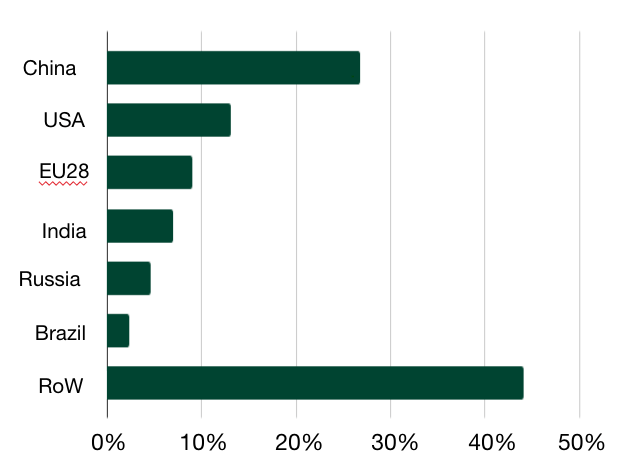
The world’s top four CO2e emitters (China, USA, EU28 and India) account for roughly 55% of CO2e emissions
Source: UN Emissions Gap Report 2019
The world needs to do more in the fight against climate change. We require an annual 7.4% reduction in CO2e emissions in order to meet the 2030 targets set by the Paris Agreement, which state that annual CO2e emissions should stand at 26 Gt; current annual CO2e emissions are 55.3 Gt. This is shown in Figure 2.
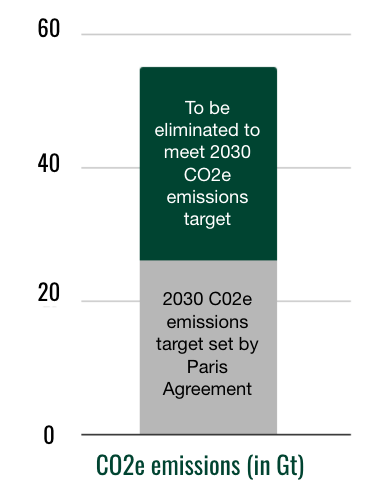
The world needs to cut its current annual CO2e emissions by half in order to meet the 2030 targets set by the Paris Agreement
Source: UN Emissions Gap Report 2019
Climate change, if unchecked, can lead to devastating consequences for the environment by the end of the 21st century, according to the UN Environment Programme and the Carbon Brief. > 70% of all coral reefs will die and there will be a 9% increase in ocean acidification (against 2005 levels), resulting in degraded ecosystems in the world’s oceans. Insects who help in pollination of crops and plants will see a loss in 50% of their habitats. There will be a rise in sea-levels by roughly 20 inches, leaving over 200 million people vulnerable to forced displacement.
Cement contributes to climate change and is key to physical infrastructure development
A significant, and often over-looked contributor to CO2e emissions is a key component of physical infrastructure: cement, which contributes to roughly 3% of global CO2e emissions. This is highlighted in Figure 3. CO2e emissions from cement production will need to fall by at least 16% of current levels by 2030 in order to meet the targets set by the Paris Agreement.
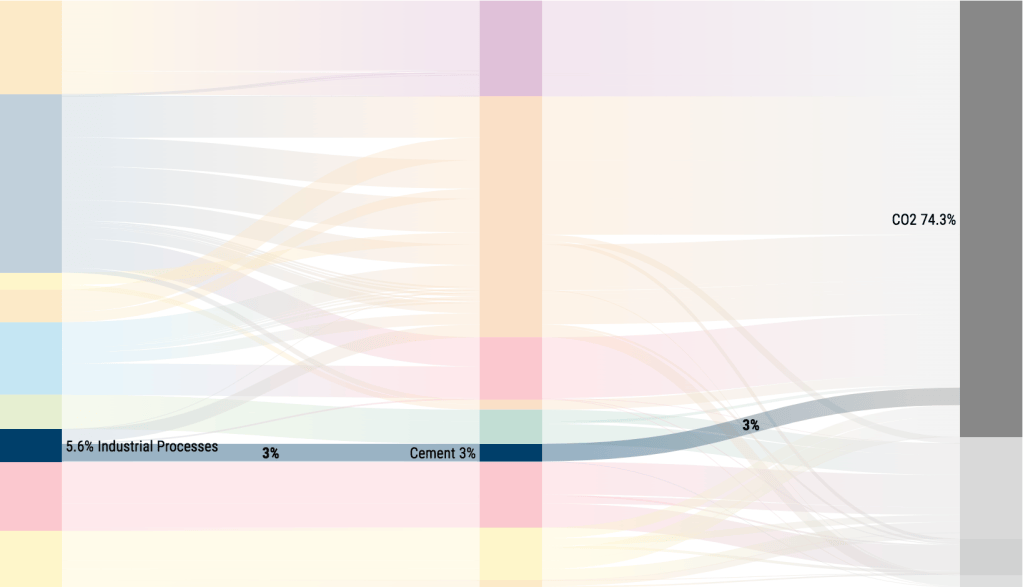
Cement contributes to 3% of global CO2e emissions
Source: World Resources Institute
There is a specific driver for the high levels of CO2e emissions associated with the cement production process: clinker production. Clinker is a solid, stony material and is the key constituent material of cement. Figure 4 details its position in the cement production process. Along with thermal combustion, roughly 90% of CO2e emissions in cement production can be traced back to clinker production.
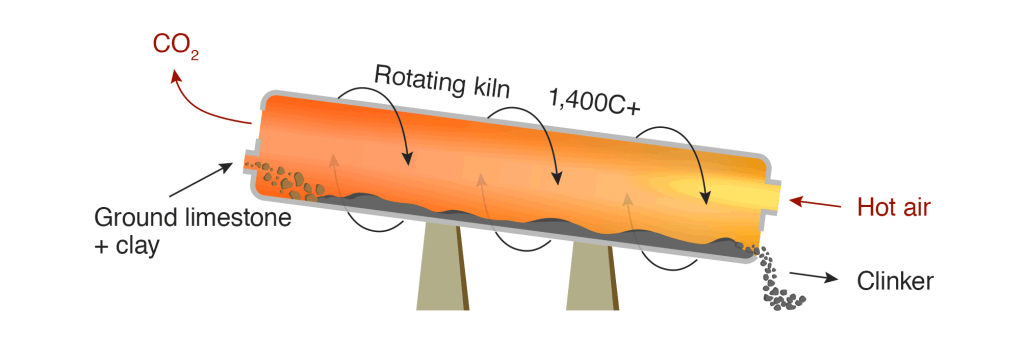
Clinker is a key product of the cement production process
Source: BBC News
Along with facing the global challenge brought on by climate change, the world – including both developed and developing countries – will see massive investments in infrastructure to better accommodate growing populations. According to the New Climate Economy report by the Global Commission on the Economy and Climate, $90 trillion will be spent globally through 2030 – 2/3rd of this in developing countries – exceeding the value of all current infrastructure stock.
Cement is perhaps the most crucial component to any physical infrastructure – buildings, roads and bridges. Thus, unlocking the low-carbon / green potential of cement is likely to yield significant financial and environmental returns, given the industry’s harmful effects on the environment. The same New Climate Economy report suggests that an economic gain of roughly $26 trillion can be realized if investments are made in low-carbon technologies and resilient infrastructure, rather than conducting business as usual.
CarbonCure offers a solution to unlocking concrete’s low-carbon, green potential
CarbonCure is the world leader in CO2 utilization technologies for the cement and the concrete sector. The firm seeks to introduce CO2 recycled from industrial emissions into the cement production process, with a mission of reducing CO2e emissions by 0.5 Gt every year. CarbonCure’s patented technology is retrofitted onto existing concrete plants, thus there is minimal incremental investment involved for incumbent cement / concrete manufacturers.
CarbonCure’s injection of CO2 in the cement production process leads to the formation of calcium carbonate. Calcium ions present in cement react with carbonate (CO2 injected into the wet concrete mix) to generate limestone (i.e., calcium carbonate). This is highlighted in Figure 5. Thus, CO2 is now trapped in this limestone mineral that becomes permanently embedded in concrete.
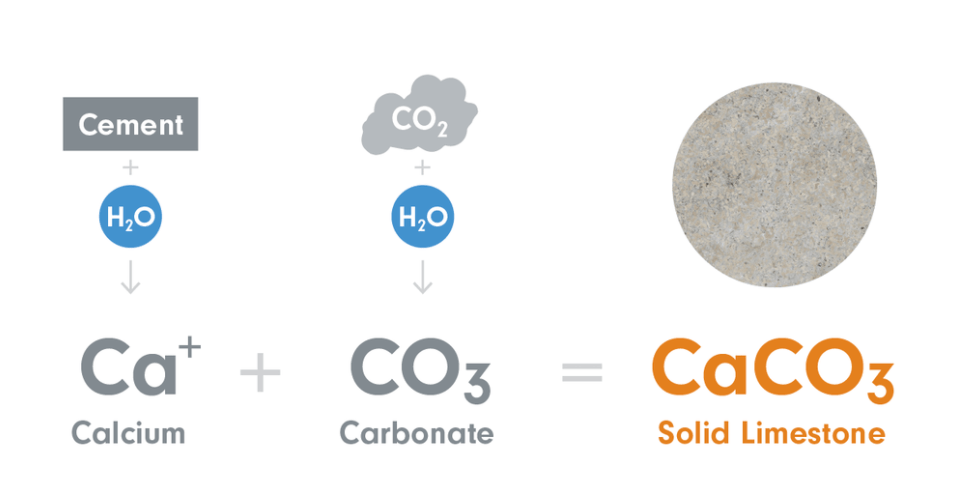
Calcium ions from cement react with carbonate (CO2 mixed in wet cement) to product calcium carbonate (i.e., limestone)
Source: CarbonCure
The company is backed by Breakthrough Energy, a global group of 28 high net-worth investors from 10 countries committed to funding clean energy companies. Breakthrough Energy was founded by Bill Gates, and has notable personalities on its board, including Mukesh Ambani, Jack Ma, Jeff Bezos, Richard Branson and Michael Bloomberg.
The OSD – IP debate with CarbonCure
As a for-profit company, CarbonCure is able to enjoy incremental growth by leveraging its patented technology. Such use of patents is often frowned upon by the broader open source community. However, I often hold a contrarian view on this, despite being an advocate of open source principles.
CarbonCure has introduced a revolutionary technology in the cement industry. Without protecting itself to ensure future growth by use of IP and patents, the company’s founders and their creative innovation would not have seen the same levels of success. It is very likely that giants in the mature cement industry, such as Lafarge and Heidelberg, would have replicated the technology in-house, if CarbonCure were to adopt a pure OSD approach. Thus, the use of patents and IP was necessary for the company to make its mark amongst the giants of the cement industry across the world.
Further, it is key to note that CarbonCure regularly release white papers and case studies on its website for the public. These detail specific use-cases for its technology and success in CO2e emissions reduction associated with these use-cases. Thus, despite not embracing OSD in its pure form, CarbonCure does adopt open source principles in order to regularly update the world on its progress in the fight against climate change.
The company’s hybrid OSD-IP approach is one that I believe may be the right way for younger companies to excel and find relevance in highly competitive industries. This is similar to my thoughts shared in the first blog post of this series. This is also similar to Professor Etienne‘s thoughts on Babylon Micro-Farms and their use of the hybrid OSD-IP approach.

