Educational inequality refers to the unequal access to education. There are multiple drivers for such inequality: policy in government, difference in schools attended by the child, family’s socioeconomic status and the race & ethnicity of the child. This blog will focus on how the difference in schools attended by the child drives educational inequality. Further, we will explore how open source education can provide an answer to a reduction in educational inequality.
The public school problem in America
Public and private schools differ by source of funding. Private schools are funded by tuition, gifts, endowments, private corporations and fundraising events. Public schools are often funded by government taxes grants, awards and donations. Financing of K-12 education is almost shared equally by local and state governments, with the federal government covering less than 10 percent of the cost (Brookings). As with any sector with private and public players, one would expect the public sector to be more inefficient in achieving the same outcome. Unfortunately, this holds true in the case of education and is highlighted in Figure 1.
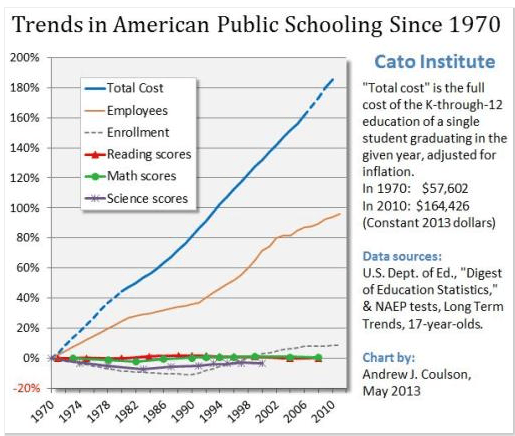
Despite rising costs, the public schooling system has hardly moved the needle in educational outcomes.
Source: Foundation for Economic Education
Public schools rely heavily on local government taxes as a funding source. This means that poorer neighborhoods are more likely to have lower-funded public schools compared to more affluent neighborhoods. This dynamic is also described in a widely-acclaimed Sociology paper by Professor Junia Howell, who states that “Educational inequality is driven by the compounding privileges of the most advantaged residents”. Findings from her research are shown in Figure 2, which shows a negative correlation between predicted educational attainment and neighborhood disadvantage. In other words, living in a neighborhood with lower number of disadvantages (represented on the x-axis) will likely lead to higher educational attainment (represented on the y-axis).
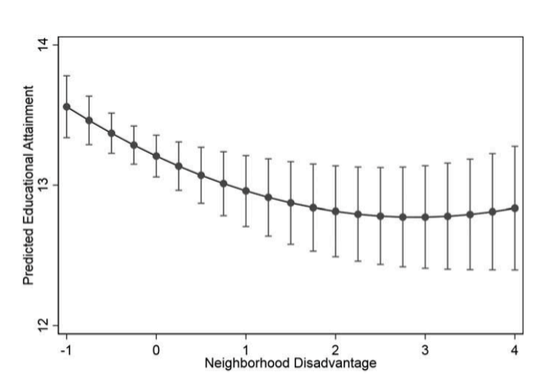
There is a negative correlation between predicted educational attainment and neighborhood disadvantage.
Source: Junia Howell
There is further evidence of this relationship. Nationally, high-poverty districts spend 15.6% less per student than low-poverty districts do. The results of such inequality are the following: lack of equal access to education, inadequate number of teachers, lack of academic and non-academic facilities and chronic absenteeism in poorer schools, just to name a few. Solving such discrepancies in funding can significantly improve a child’s life outcomes: a 20% increase in per-pupil spending each year for poor children leads to an additional year of education, 25% higher wages and 20 percentage-point reduction in the annual incidence of poverty (National Bureau of Economic Research).
It is interesting to note that the structure of the public school system dates back to colonial America (The Atlantic). Massachusetts set the tone for public schools to be financed by property taxes when the colony passed the Massachusetts School Law of 1647. The law stated that any town with 50 or more families were required to hire a teacher for children who would be paid via property taxes. This trend was revolutionary at the time, was picked up by other colonies, and still has its structure largely intact 373 years later. This clearly tells us that despite the best intentions of the legislature, policy is unlikely to bring about a change to the system.
In light of the above, we must come up with alternatives so that children attending public schools in poorer neighborhoods will have a better chance at success. Educational inequality is driven by the lack of access: how can we offer equal access to education to children in lower-funded schools? Open source education may just be the answer.
The open source solution
Open educational resources (OERs) may prove to be the answer to ensure a level-playing field for public schools in poorer neighborhoods. OERs are learning materials that can be modified and enhanced because their creators have given others permission to do so (Opensource.com). The world’s most popular OER is Wikipedia, which offers free content to each and every individual with access to the internet. Each of its five pillars enshrine the principles of open source. Figure 3 gives us insights into the impact Wikipedia has on the world. According to Lane Rasberry, UVA’s Wikimedian-in-Residence, Wikipedia is the fifth most visited website in the world, and the only non-commercial website within the top 10.
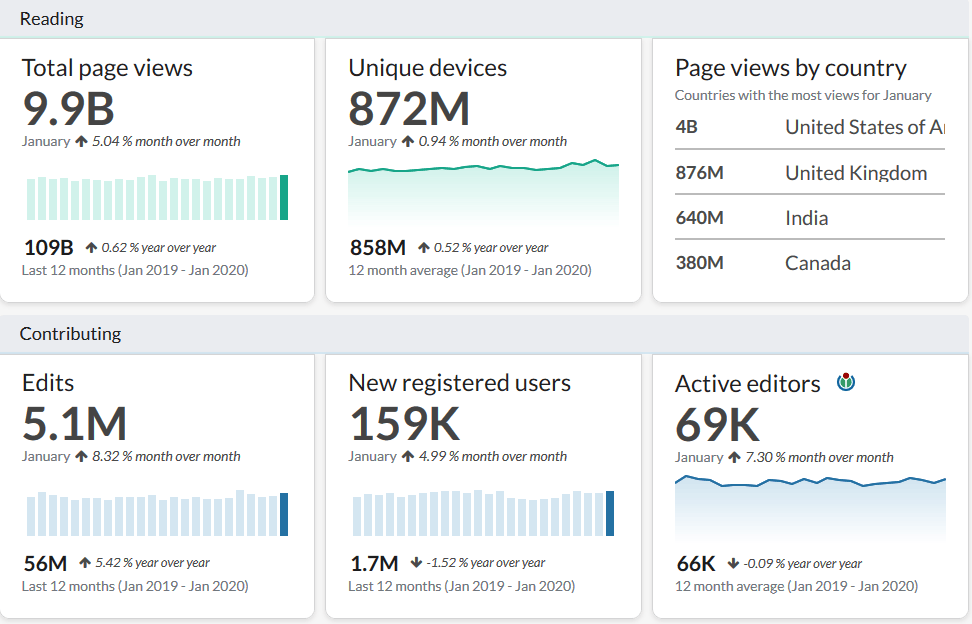
Wikipedia’s impact on the world
Source: Wikimedia
Despite being an online platform, Wikipedia strives to make itself available to individuals without internet access through its Internet-in-a-Box offering. Individuals can use their phone, laptop or computer to connect (via WiFi) to a wireless access point with storage. Content can be updated either by replacing the entire wireless access point, or only the storage, via a new memory card. This proves to be revolutionary to ensure equal educational access, even in a country like the United States. Internet penetration in the US currently stands at 87%, leaving some 45 million people without regular internet access. Further, as seen in Figure 4, there are access to broadband internet is uneven across the US; there appears to be discrepancies in the data from the Federal Communications Commission.
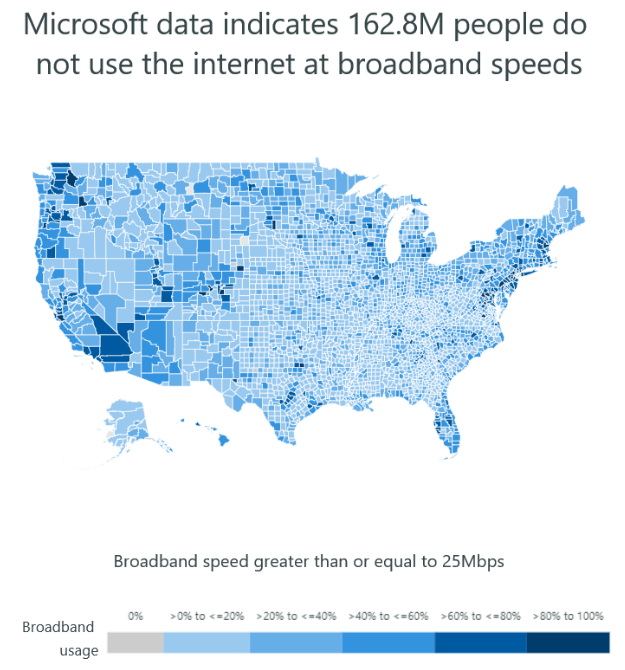
Broadband access is uneven across the United States.
Source: Microsoft
Despite its best intentions, OERs have their fair share of critics. These are often individuals and organizations who benefit from the status quo of unequal education access, as discussed in Tuesday’s lecture with Professor Etienne. A point often brought up by OER critics is the ability to manipulate content on OERs. This point is flawed. First, OERs are actively being edited by contributors (as seen in Figure 3) as well as automated bots (Lane Rasberry) who are responsible for ensuring that only neutral and accurate content is shared. Second, this point confuses OERs with open education, which often involves open access to education, irrespective of the ability to modify content and material (Opensource.com).
It is important to understand the slight nuance in the differences between OERs and open education. An example that further explains this difference is YouTube. Individuals can access educational videos on YouTube for free and are able to collaborate – via comments – on some videos; however, only the individual who uploads the video is able to modify it. This creates an issue for leveraging YouTube as an educational resource: there can be instances where false information or even disinformation can be promoted via so-called educational videos. This is what happened during the Russian disinformation campaign leading up to the 2016 general election in the United States (Politico).
Redirecting resources to OERs will ensure success
OERs can suffer from a lack of resources. As pointed out in my first blog post, open source solutions and platforms can offer suffer from a free-rider problem, where there are more individuals taking from open source than contributing. This can compromise the entire open source platform.
A solution to this problem is for governments and individuals to redirect resources (time and money) to OERs, who are likely to deliver content more effectively than existing resources, especially within lower-funded schools. For instance, Wikipedia receives annual contributions worth $100 million to fund its operations; 95% of this funding comes from individuals contributing $25 or less (Lane Rasberry).

