The Energy Information Administration (EIA) forecasts global energy demand to increase by 50% by 2050. This growth will primarily be led by growth in energy demand from Asia, with the continent’s population projected to account for 55% of the world’s population. Incumbent fossil fuel resources are unlikely to be the answer to meet this huge growth in energy demand, particularly in the face of growing awareness and evidence of the impacts of climate change. As the entire world makes achieving the goals of the Paris Agreement their top priority, we will see the rapid decline of fossil fuels in the global energy mix. Further, the growing adoption of renewable energy sources will put further downward pressure on fossil fuels. Since the 1970s, fossil fuels have made up 60% – 70% of the entire global energy sources mix. However, as Figure 1 shows, the days of the fossil fuel industry are numbered. Renewable energy sources are projected to make up about 65% of the global energy sources mix.
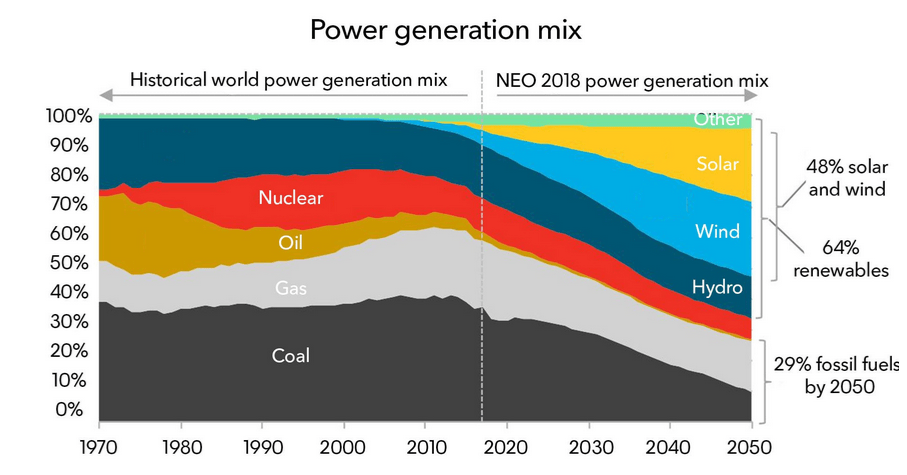
The world’s energy demand will rely less on fossil fuels and more on renewable sources.
Source: Bloomberg New Energy Finance
Despite rapid advances in battery and storage technology, we are still some years away from cost-effective storage solutions that will support large-scale renewable energy plants. As Figure 2 shows, the price of lithium-ion batteries may be cost prohibitive for households even in 2030. Thus, large-scale energy generation plants powered by renewable energy are likely to generate variable amounts of energy in the absence of cost-effective storage. This will make it difficult for utility companies to accurately forecast supply and demand for energy.
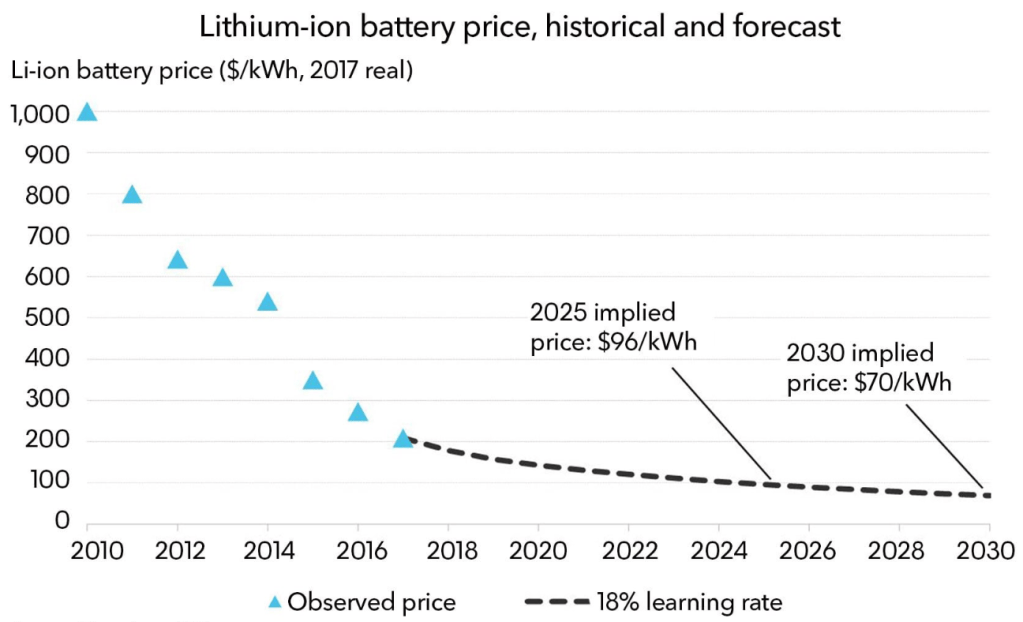
The price of lithium-ion batteries are likely to be cost prohibitive for households even by the end of this decade.
Source: Bloomberg New Energy Finance
We now face an interesting question: how can cities, regions and countries successfully accommodate the inevitable rise of renewable energy sources?
Transactive energy solutions built on OSD platforms will provide a scalable solution to successfully accommodate variable renewable energy supply across the world.
What is transactive energy?
As per the California Public Utilities Commission, transactive energy (TE) refers to “an intelligent-device-enabled grid where each device can utilize electronic signals in order to optimize allocation of resources subject to the constraints of the grid”. TE is not a new concept as wholesale energy markets currently adopt an approach of leveraging signals (usually by forecasting demand) in order to optimally allocate resources. However, the difference with TE is the extension of this concept to end consumers to participate directly in energy markets.
TE can be applied to a localized area, such as a neighborhood or community, or to an entire national grid system. In a localized area, TE adopts more of a peer-to-peer approach. Individual households can be both consumers (as per their traditional roles) as well as producers (often re-phrased as “prosumers”). Consumers and prosumers trade energy in an energy marketplace, which is often a digital / intelligent platform that is increasingly powered by blockchain. In some cases, consumers have the option to buy energy from incumbent utilities as well.
Thus, there is a key difference in energy distribution with TE. Traditionally, energy distribution was and largely continues to be unilateral, i.e., energy is distributed from a utility to end consumers. However, with TE, we will see a multilateral approach to energy distribution, where all parties in the grid will serve as consumers and producers, and where the price of energy is determined by a free and fair market system. This will lead to a democratization of the energy market, where current utility monopolies will no longer be able to dictate prices and may in fact even be phased out. An illustrative example of a TE market is shown in Figure 3.
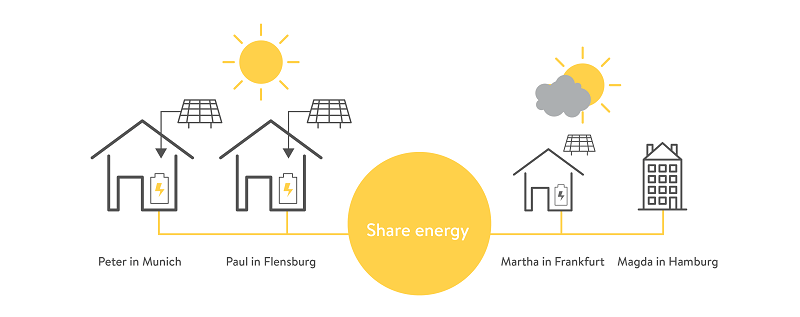
TE will democratize the energy market.
Source: sonnen USA
Despite being a relatively new industry, TE is poised to see a huge growth for most of this decade; Navigant Research predicts that the TE market will grow by 153% through 2028 and reach $7.9B. However, these estimates assume an IP-oriented TE industry, which may in fact limit the size and scale of the TE market, as we will discuss in a later section.
Brooklyn Microgrid: a TE success story
Brooklyn Microgrid (BMG) is a TE project funded by LO3 Energy (LO3), that involves peer-to-peer solar energy trading. BMG has received significant praise and accolades for the role it has played in bringing the TE industry to the limelight. This has seen LO3 implement TE pilot projects in the UK, Colombia, Japan and Australia. Further, LO3 has received investments from two global energy giants: Royal Dutch Shell, Japan’s Sumitomo Corporation and Siemens. BMG has been at the forefront of tapping into emerging consumer trends: 69% of consumers are interested in having an energy-trading marketplace, while 47% of consumers plan to sign up for community solar projects.
BMG leverages the core concepts of TE identified in the previous section above. In addition, the BMG energy marketplace developed by LO3 leverages blockchain to support peer-to-peer transactions. As IBM points out, blockchain drives greater transparency, enhanced security and improved traceability. This is crucial to BMG’s success. Any product or service that seeks to disrupt the status quo must secure the trust of end users. Leveraging blockchain enables BMG to do so. In the absence of blockchain, users would probably still have a central authority – a pseudo-utility – that governs the marketplace. This would serve as a disincentive for end users and would likely limit adoption rates of TE.
OSD will unlock the true potential of TE
Exergy – the energy marketplace developed by LO3 that enables BMG users to trade with one another – is currently proprietary to LO3. As has been explained in my first blog post, such IP protection limits the spread of the benefits of this innovation. Specifically, IP-backed innovation is unlikely to be spread fairly to the developing world. This has serious implications for the energy industry; a significant portion of the developing world currently has no access to electricity – driving energy inequality – as seen in Figure 4.
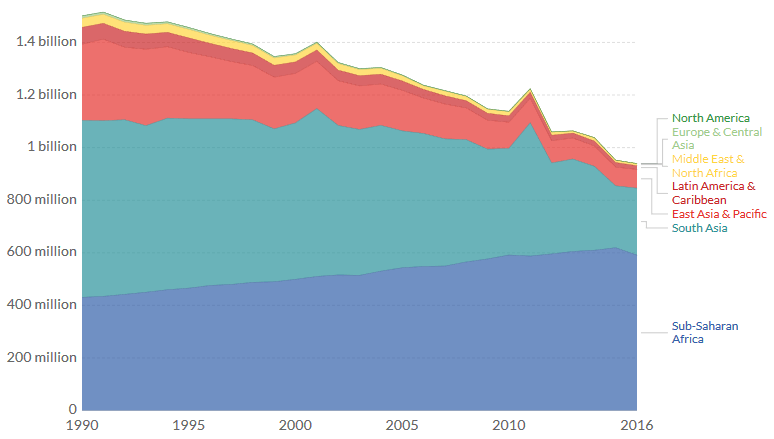
A significant portion of the developing world lacks access to electricity.
Source: Our World in Data
TE’s promise to democratize energy will achieve monumental impact in the developing world. The number of people gaining access to electricity has been growing around 118 million each year since 2010. However, this pace is slowing as those without energy access are either remote or poor, or both. By leapfrogging energy distribution through utilities, the developing world will be able to leverage TE to ensure local access to energy at fair prices for all. This is likely to drive a reduction in economic inequality. The benefits of TE will be distributed more fairly by adopting an OSD approach. Local entrepreneurs across the world, including in developing countries, would be able to develop their own energy trading platforms that work for their specific communities.
Adopting an OSD approach does not mean forfeiting all profits, even in the case of peer-to-peer TE. For example, Professor Etienne recently conducted a class poll to understand how many students would individually and actively manage their energy usage and consumption, a key component of TE. Very few students expressed interest, indicating a potential business opportunity for firms to offer personalized services as per individual customer needs and preferences. The firms would determine energy trades for individual customers as per each individual’s energy consumption and energy goals.
As with any proposed solution that disrupts the status quo, there will be stakeholders that express opposition to change. In the case of OSD-backed TE that seeks to disrupt the energy industry, one key stakeholder comes to mind: incumbent utilities. These utilities will likely oppose any efforts to implement off-grid energy sources that threaten their monopoly status. There may be room to consider the role of utilities in a TE ecosystem. One option is to have utilities – through renewable energy sources – serve as a prosumer in the TE network. Another option is to have utilities participate in a key support-services role that seeks to offer unique support to the OSD-backed energy trading platform.

